
Picture books are known for their rhythmic, almost musical language. But what are the challenges in writing nonfiction when the story is ABOUT a musician? One of my most difficult writing projects was a picture book biography about musician Bill Monroe. Struggling to find how to explain music in words took months and more months. I know what bluegrass music SOUNDS like, but how to SAY what it sounds like? How to make the rhythm of the words match the music?
When I heard about a debut picture book biography about blues musician CeDell Davis, I wanted to find out how another author approached this difficult challenge (and for his FIRST children’s book too!)
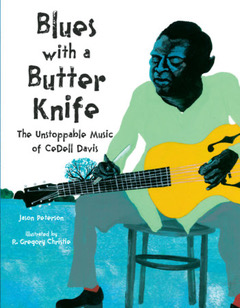
I got in touch with author Jason Peterson about BLUES WITH A BUTTER KNIFE, which was published by Calkins Creek in September. I had a few questions for this musician and music writer on the challenges of writing about sound.
When did you first hear of CeDell Davis and why did you feel his story was important for children?
I first heard CeDell’s music in college with his record When Lightnin’ Struck the Pine, which he recorded with some of the alternative-era musicians I was more familiar with at the time. I’m from Chicago and have been playing guitar and bass since my teens so naturally had a love for Buddy Guy and Muddy Waters and Chicago blues, but I hadn’t really gone back to their early years and their influences as much as I should have.
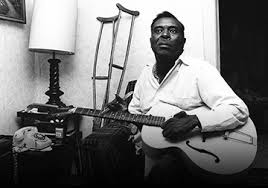
Years later I had gotten into listening to a lot of Delta blues musicians and reading books and watching documentaries about it – and I’d been living in Louisiana with two young kids reading a ton of picture books and writing books for young readers. It all kind of came together with CeDell and this book. The words that ended up opening the book just kind of tumbled out, and I kept going with it.
Researching and writing it led me to so many incredible people who were passionate about CeDell and his music. I hoped if his life and music – the way he played and just went for it – spoke to me and to them so much, it would for young readers as well.
You’ve written for adults before, what was different about writing for children?
I’m not sure I approach it too differently starting out. Each story begins with interest and curiosity and just getting words down on a blank page and going from there. However, because of the audience, you really need to be mindful of each word and what it does for the story – much more like songwriting, which I also love. Each word is so important.
There is also the read-aloud factor, where I’m picturing a parent or teacher or librarian reading each page to a child or group of children. Those thoughts weigh into word choice and rhythm and (hopefully!) keeping everyone engaged.
I have to give a shout-out to here to two things: one is Vivian Kirkfield’s #50PreciousWords and the writers who submit to it. Participating and reading everyone’s entries has had a huge impact on how I write – trying to strip the story down as much as possible, and then build it back up where needed. Also, my editor Carolyn Yoder kept coming back to the questions: why does this matter, and why would it matter to children? Keeping those questions at the forefront were so helpful with this book and continue to be in my writing.
What were your biggest challenges in writing a picture book about music? Did you learn anything from the format?
There’s that one quote I come back to often: “Writing about music is like dancing about architecture.” Bringing music to the page can seem futile, but then you remember there’s a brilliant illustrator who will have their say, and editors and art designers that will shape it, too. Hopefully it will all come together into something that captures what’s so special about music and the people who make it.
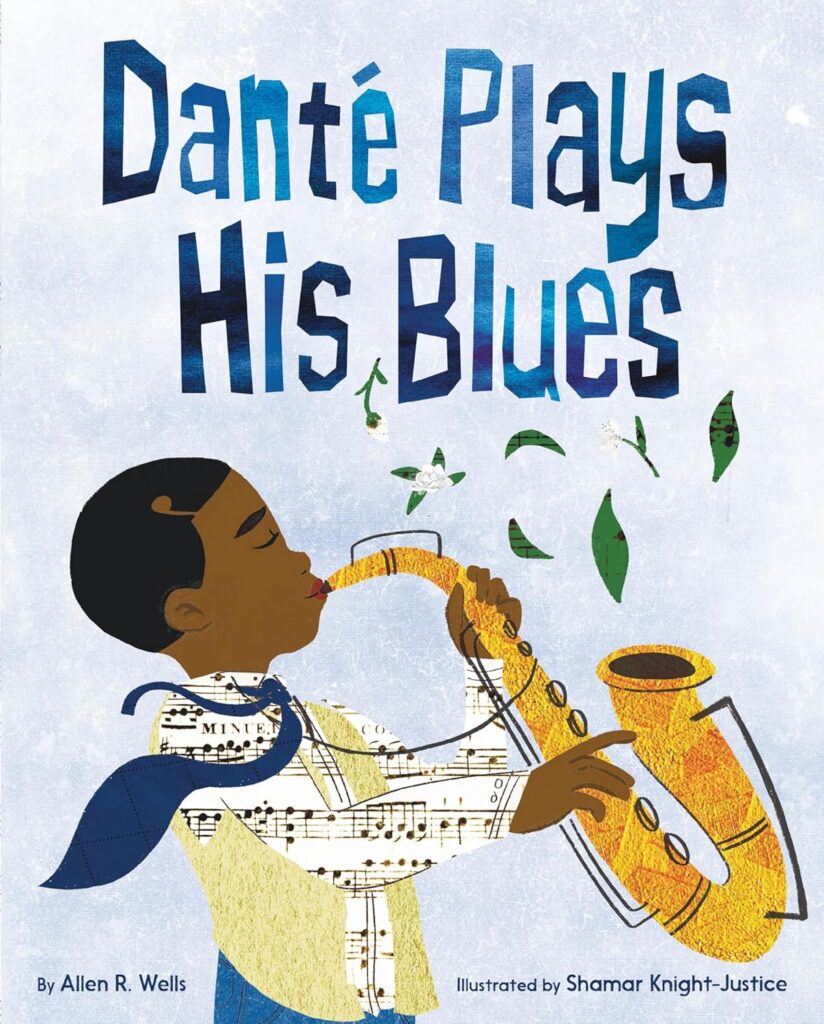
Reading books is so inspiring, too book. Diving into a book like Dante Plays His Blues by Allen R. Wells and Shamar Knight-Justice and so many others that does it so wonderfully – you see that it can be done. Picture books have an advantage of incredible illustrators that can take the words and run with them and bring their own beauty and musicality to the art.
It becomes its own thing – and hopefully, it also inspires readers to give the music a listen, too (or even pick up an instrument and play!). It can all come full circle.
Once you saw the sketches for Greg’s (R. Gregory Christie’s) illustrations, did you wind up changing the story or any of your language choices? Tell us your reaction to the art.
Well first, when I got the news that Greg had signed on, I was completely over the moon. Knowing R. Gregory Christie would illustrate a book with words I had written was definitely a ‘pinch-me’ moment. Seeing his sketches come in just confirmed that over and over all the way through to the finished art. I can’t say enough about his choices in everything from background colors to the details he brought out. Just incredible. I find something new to love every time I turn the pages.
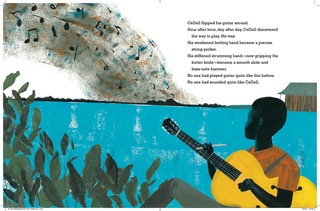
Seeing Greg’s art come in was a great lesson for me in just how much you can trust an illustrator and not need to “illustrate” with the text. As a writer with next to zero artistic skills, it’s so tempting to over-write descriptions – not just art notes, but in the text itself. It was really freeing to trust that this incredible artist would bring his passion and skills and create something worlds beyond what I could try to specify. We could strip the text down and let Greg’s amazing art do its thing.
When I wrote Blue Grass Boy, I had the hardest time “translating” music into words. How did you think through that for Blues with a Butter Knife? Did you come up with any strategies that helped you in the writing?
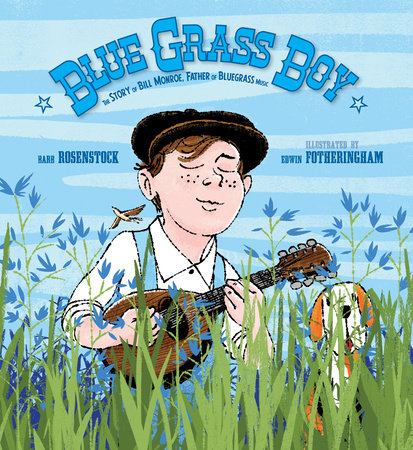
I’ve loved reading so many music-themed picture books – not as a purposeful preparation for writing this book necessarily, but because I have two young kids and love music and reading with them. But it really did help when I was working on this book and others I’ve written and am working on. There are so many books that do that “translating” so well – your book, Blue Grass Boy, being one of them that we’ve loved to read.
For this book, the rhythm was so important to get right. It doesn’t always follow a strict meter, but I wanted it to flow and have certain parts come back like a chorus. CeDell’s music has a rolling feel and spontaneity that isn’t always locked in to the 12-bar blues, and I wanted this book to have a similar vibe.
My first drafts were very sparse, and we ended up needing to add a little more context to make it all make sense as a story. But with each revision, I still tried to keep that rhythm of the read-aloud top of mind.
Can you share what you’re working on currently?
I’m always on the lookout (…and listen-out?) for something or someone musical to write about for a picture book. I have a few irons in the fire there – including a book about Bob Dylan I’ve been so fortunate to work on with Carolyn and the amazing team at Calkins Creek once again.
I write middle grade too and am working on a few projects in various stages of completeness that will hopefully find a home down the road. I also recently picked up a five-string bass after playing four strings my whole playing life, so I’m trying to figure out how to make that low B work!
THANKS to Jason for answering my questions and teaching me that all nonfiction picture writers are “dancing with architecture” in a lot of ways, or maybe singing with science, or drawing with history, or…
Jason has agreed to give away one copy of BLUES WITH A BUTTER KNIFE in a random drawing. Comment on this post to enter. The winner will be announced in my next post on December 8th! GOOD LUCK!

Jason Peterson is a writer and musician who has written for Performer Magazine, American Songwriter, Living Blues, and The Onion News Network, among others. When not writing, Jason can be found building a to-be-read pile of books that will hopefully not topple over – and also playing bass guitar. He was born and raised in Chicago and now lives with his wife, two kids, and a scruffy dog in south Louisiana, where he’s still getting used to trading in snow for swamps.

I love true, inspiring stories such as with BLUES WITH A BUTTER KNIFE. And here, the musicality and history are captured so well in both words and images. Congrats, Jason! I hope many readers enjoy your book.
Thanks Robin, maybe you’ll win the book!
I love thinking about how to write sounds and smells — like looking for one big metaphor. Thank you for the peek into both of these stories.
You are so welcome!
Aren’t illustrators amazing? I have to label my stick COWS, but my illustrators have always found just the right medium and style.
Yes, illustrators ARE amazing!
Oooh, this book sounds fantastic! Congrats!!!!
Hope you get the copy!
The book looks gorgeous! Congrats to Jason on this debut!
It IS gorgeous!
As a flutist, I’m always interested in learning about other musicians and can’t wait to read this book. I enjoyed the editor’s questions for the author–“Why is this important?” and “Why would it matter to children?”–and will keep those in mind for myself.
That is the first question I ask myself before going ahead…Why would it matter to kid?
Congrats, Danielle! Hope you enjoy the book! 🙂
Congrats on your book Jason. I love Vivian’s 50 precious words contest. It has helped me as a writer as well.
Vivian is the BEST!
I think this topic is brilliant and can’t wait to read it. I love looking at how the illustrator reacts to the words and this looks like it won’t disappoint.
Even as an author, I say that the illustrators have the MOST important job in a picture book!
I love books that gently teach children AND adults! A perfect blend of fun and education!
That’s a good pair, right Kathy?
You had me a the title, and I love R. Gregory Christie! Can’t wait to feel the music and meaning.
Love Greg’s work! Good luck on the giveaway!
Writing about a sound is truly a challenge. Congrats to both of you!
I think Jason nails it here! And it’s not easy!
Wow! Beautiful book–love the title!!! I love books about music and musicians because they’re able to express what feels so inexpressible, what music does to a soul. So you have my admiration and congratulations!!!
Writing a picture book is like writing a song, so I’m not surprised the format fits well with musicians, it’s just hard to “talk in song” Right? Good luck!
I never thought about the challenges before or writing a book about music and musicians. This was a interesting read!
Thanks! Good luck winning the book!
Thanks for sharing specific practical things you learned while writing Blues with a Buuterknife. The title with no other information would make me pick this book up!
I just wanted to say thank you to all for your thoughtful comments and interest in Greg’s and my book. Thank you, too, to Barb for coordinating this interview and for your questions – and to Picture Book Builders for having me.
Many thanks!
My grandkids love music – I can’t wait to get my hands on BLUES WITH A BUTTERKNIFE and share it with them. Congratulations Jason & Greg!