
Hello Picture Book Builders!
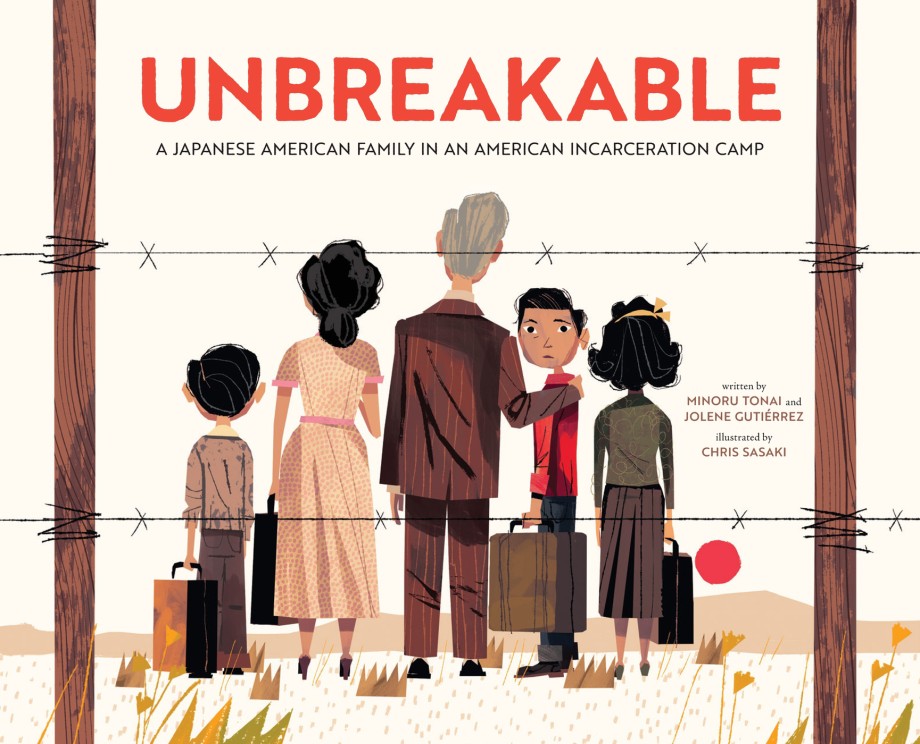
Today, I am so honored to be able to share a truly special book with you all: UNBREAKABLE: A Japanese American Family in an American Incarceration Camp, written by Minoru Tonai and Jolene Gutiérrez, illustrated by Chris Sasaki.
Here’s my review:
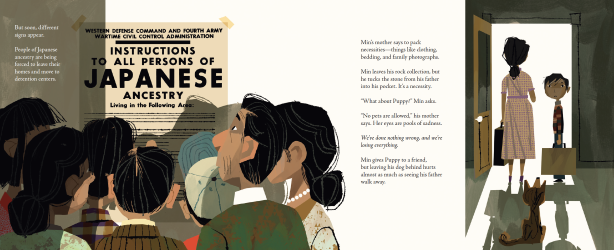
Wow. This masterfully written and beautifully illustrated book tells the true heart-breaking story of Minoru Tonai and how, during World War II, his father was arrested by FBI agents and imprisoned while the young boy and his other family members were uprooted and made to live in an incarceration camp – all because they were Japanese. As a Jewish person, I found the descriptions of Min’s experience chillingly similar to the horrors experienced by millions of Jewish families in Europe during WWII – good and loyal citizens suddenly torn from their lives, caged and forced to live in inhumane conditions, labeled as dangerous (literally, having to wear a visible marker to identify them), and stripped of all dignity simply because those in power needed someone to blame. The Authors handle the heavy topic here with such grace. The language is kid-friendly, yet deeply honest. Readers will empathize and connect with Min’s feelings of confusion and fear. I appreciate that the Authors never sugar-coat what happened or the horrible things people and governments are capable of when they feel threatened, and yet somehow in the end, the Authors still manage to deliver a message about the power of resilience and offer us hope for humanity. Back matter, including Author and Illustrator notes, a timeline, and questions for discussion are included to help inspire important conversations. An incredible book that is deserving of all the awards I’m sure will be coming its way.
Jolene and I are agent-sisters, so I was lucky enough to see an early copy of the book. Obviously now, the word is out and, not surprisingly, it has already received FOUR starred reviews and is getting its well-deserved book buzz.
I’m so grateful that Jolene is here to talk about this absolutely gorgeous and important book. Welcome, Jolene!
RGL: How did you come to be friends with Minoru and learn about his story? When did you know you needed to write a book together about it?
JG: When I was 12, I first heard about Amache Incarceration Camp from my grandparents one summer and I was so frustrated that I hadn’t learned about Japanese American incarceration camps during my Colorado history classes. When I became a teacher librarian 30 years ago, I started teaching lessons that included the history of Amache. Each year that I taught about Amache, there were a number of students and teachers who would say things like, “Before your lesson, I’d never heard about this,” so in 2016, I decided to work on a nonfiction middle grade book about Amache. I was researching and interviewing people when a friend, Dan Yoshii, introduced me to Minoru Tonai. Min had been incarcerated at Amache with his family and his story was so powerful that after I spoke to him, I asked Min if we could focus the book on his family’s story. We worked together from 2017 to 2023, when we sold the manuscript to Abrams Books. Min passed away soon after, but I’m so grateful he knew his story would live on.
RGL: I’m so sorry for your loss. I know he would’ve been so proud to see all the praise you are getting for this book. I thought your choice to write Min’s narrative in the present tense was so smart. I think all too often when kids read about “history,” they think of it as “something that happened a million years ago and has nothing to do with what I’m going through now.” But by writing in the present tense, you bring immediacy to the story and a here-and-now reason for readers to connect and empathize with what Min “is” going through. Tell us more about why you made this craft choice? I’m also curious if you played at all with POV and why you landed on close 3rd person vs. 1st person (especially since Min himself co-authored the book).
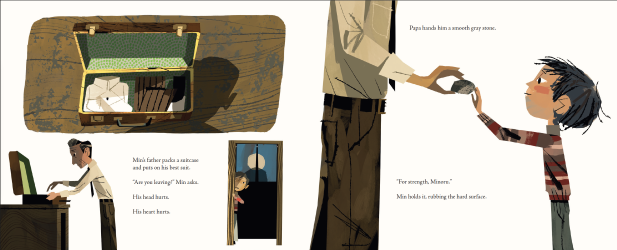
JG: As a teacher, it’s very important to me that my students practice putting themselves in others’ shoes. By writing our story in present tense, hopefully readers feel like they’re there with Min. And speaking of Min, my co-author struggled with the fictional element we added to the story—the rock that Papa gave Min before the FBI took Papa away. Since Papa didn’t actually give Min a rock and because Min knew the picture book character would likely be illustrated as younger than Min was during the incarceration (he was 13 at the start of the war), close 3rd person felt better to him. Everything else that happens in the story is real and true, though.
RGL: In addition to being an author, I know you are also a librarian at an 2nd-12th grade school in Denver. Have you shared the book with your students? What feedback have you received from them? Has anything surprised you about their reactions to Min’s story?
JG: Very early on in the writing process—maybe in 2018—I read an early draft of a picture book version to one of my classes. They were polite, but I could definitely tell where we’d overwritten and the fact that we didn’t have illustrations made it difficult for my students to connect to the story. I showed them photos, but it just wasn’t the same. Recently, I shared the finished product with some of my 6th grade and high school students and wow, what a difference. This time around, my students were IN the story with Min. They experienced the losses and pains Min experienced and they were with me the entire time through. And this didn’t really surprise me, but I was grateful for their reactions: many of them expressed how upset they were. They understood how unfair it was that this happened to Min’s family and 120,000+ other people, and they made connections to other times in the past and in present day when people were treated unjustly and families were separated.
RGL: Your students’ connectedness to Min and their outrage about his treatment is a testiment to your beautiful empathetic wrting. So well done. What was the most challenging part of the writing process for this one?
JG: Finding the right format. Min was a businessman, so his writing voice was more factual and included lots of details. We first wrote the story as a middle grade nonfiction book, but it didn’t have the heart I wanted it to. Then we tried it as a picture book, and that felt better, but there was still something missing. I tried scripting the story as a graphic novel script, with no luck, and then in 2020, I was watching a virtual pilgrimage and Min spoke, telling a story about his father bring released from prison after over 3 years and coming to join Min and his family at Amache. When Min tried to lift his Papa’s suitcase, he learned it was filled with rocks from each of the prisons Papa had been held in. They used the rocks to create a rock garden outside their barracks. I knew that Min and his Papa created rock gardens both before and after being incarcerated, so hearing that rocks were also important during their family’s incarceration felt like an important throughline. We started revising our picture book manuscript with that thought in mind and the rest is history.
RGL: Amazing that this went through so many iterations before finally finding the perfect format and theme for this story! What do you hope children most take away from your book after reading it?
JG: I hope they read this story, open their hearts, and feel the losses that the Tonai family experienced. I hope they get angry, just like I did all those years ago, that thousands of people were imprisoned unjustly and held for years without due process. And I hope that readers will learn from the past so that we don’t keep making the same mistakes.
RGL: I truly, truly hope that too. And now, my favorite question to ask my guests: What is one question no one has yet to ask you about the making of this book that you would love to answer? (And what’s the answer?!)
JG: Here’s a question I haven’t been asked yet: “Is this the original title?” The answer is no. We went through a few different titles over the years including the following:
- Speaking Out
- Standing Strong
- Don’t Call Me #12803c
- Imprisoned Innocents
RGL: Oh, how interesting! I think you ended up landing on the perfect title, though. Thank you again for sharing the story behind the story for this wonderful book, Jolene.
And now, dear readers, I have a giveaway for you! Jolene and her publisher, Abrams, has agreed to send a copy of the book to one lucky reader (Continental U.S./non-P.O. box addresses only, please). To enter, simply comment on this post! I will announce the winner on my next post, scheduled for 6/30/26!
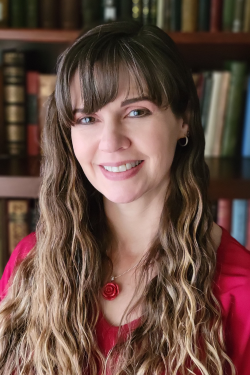
Jolene’s Bio:
Jolene Gutiérrez grew up on a farm in northeastern Colorado, surrounded by animals, plants, and history. Now, she lives with her family and a variety of animals near Denver, where she is an award-winning neurodivergent teacher librarian who has been working with neurodivergent learners since 1995. Jolene writes for young readers and hopes her books will help some readers feel seen and will help others learn and grow in compassion. Her books have been printed in nine countries and eight languages and include the recipient of four starred reviews, Unbreakable: A Japanese American Family in an American Incarceration Camp (co-authored with Minoru Tonai); Mamiachi and Me: My Mami’s Mariachi Band (co-authored with her son Dakota); winner of the 2025 Crystal Kite Award for the Southwest Region, The Ofrenda That We Built (co-authored with her daughter Shaian); and Too Much! An Overwhelming Day. Jolene is represented by agent Kaitlyn Sanchez. Find her online at www.jolenegutierrez.com or on Facebook, Bluesky, Instagram, or Threads @writerjolene.

Jolene, when I saw your name on the cover, I knew I had to find out more. UNBREAKABLE is the book US History classes (an politicians) all need to read. Congratulations on the starred reviews, but more importantly for getting this important book into readers’ hands.
Joyce, I’m so grateful for all of your support and kind words. Thank you, thank you! <3
Congratulations on the starred reviews and on bringing an important story to children and adults.
Thank you so much for your kind words, Kathryn!
I can’t wait to read this important book.
Jody, thank you! I appreciate your support.
Wow. Great interview. I will make sure my library is carrying this book. It’s so important that more people read these stories and understand that history is repeating itself.
Debra, thank you so much for reading. I’m so grateful that you’ll ask your library to order a copy, too–as a librarian, hearing that others have asked their libraries to carry my books is the BEST gift!
Congratulations to Jolene & Min for sticking with this important story and finding a way for it to inform and touch young hearts. Congrats, too, on the many starred reviews it is receiving! Thanks for this post, Rebecca. It’s always interesting to hear the story behind the story.
Thank you so much for reading, commenting, and celebrating with us, Jane!
How powerful! Thank you for sharing!
Thank you so much for reading and for your support, Katie!
Congratulations Jolene! This is indeed a powerful story and one that needs to be told now more than ever. Like you, I never learned about Japanese internment in school. I look forward to reading this!
Oh, Laura, thank you so much for your support and being interested in reading UNBREAKABLE!
This is such an important book – and beautifully done!
Thank you so much for your kind words and support, Robin!
What an amazing journey for this moving story! So many decisions to be made. Your experience reading to your students shows that powerful magic of words and pictures in a picture book. Congratulations!
I’m so grateful for your support and kind words, Patricia!
I only heard about these camps as an adult and want to thank the author for sharing this important historical time with kids–I wish I had known much earlier in life. I can’t wait to read this and learn more. I have many Japanese friends currently, but none who experienced these camps, thankfully. This book will open eyes and hearts.
Danielle, thank you for sharing your experiences and for picking up a copy from your library! I’m so grateful.
I checked this book out of my library this morning and can’t wait to read it. Thank you to the author for sharing such important historical time with kids–I never got to learn about it until I was an adult.
This is one of those stories that makes me feel embarrassed that our country would let this happen. I’m happy that you and Min worked together on this project. Excited to read it and enjoy the illustrations.
Thank you so much for reading, Tricia, and for your support. It was my honor to work with Min to share his story.
It’s especially apparent at times how important it is to never forget, and to retain what we learn from history. I’m really looking forward to this book. Thank you, Jolene and Rebecca.
Thank you so much for your kind words and support, Sue.
What an important book. I cannot wait to read it.
Thank you so much for your support, Loreli!
What a great topic for a kids book!
Thank you so much, Gee! This is a story I needed to know when I was younger and I hope it’s helpeful for others.
This book sounds absolutely wonderful and meaningful.
Thank you so much for reading and for your kind thoughts, Kathy!
Wow, I recently discovered this blog, and I love finding these kinds of treasures through it. I can’t wait to read it and see the beautiful illustrations.
Thank you so much for being here and reading our interview, Alejandra! I hope you get your hands on a copy and yes, Chris’s illustrations are so powerful!!
What an incredible book and much needed. I have to read this one and wishing you both all the success deserved with this outstanding story.
Thank you for your support and kind words, Dee! I’m so grateful!
Congratulations! I’m Generation X, and I feel the story of the Japanese internment camps was barely a footnote in history books. So glad you’re bringing this important part of our country’s past to light.
Thank you so much for reading and for your support, Mary!
I love books on empathy! If I were still teaching, I would use this book in my classroom.
Oh, thank you so much, Kathy!
Wow! This sounds amazing! What a haunting yet necessary story to share! Congratulations for getting this out in the world!
Thank you so much, Angie!
This is one of the books our picture book group is discussing this week along with Shell Song. I was struck by the fact that both had collections involved–rocks and shells. I had recently read George Takei’s My Lost Freedom, and have read a few others. I’m so glad these stories are coming out because each is unique and adds to the bigger picture. I like Unbreakable’s focus on the boy’s thoughts and feelings, but sparsely told. And the story and illustration really seem to walk hand in hand. I also like the fact that there is a little community that told this story. Min organized people to tell the story. The coauthor continued to tell the story in the back matter after Min died, and the illustrator also had a grandfather who was in the camps and then fought in the war.
I LOVE Shell Song and think it’s so beautiful to pair it with UNBREAKABLE because of the collecting aspect. I’m also grateful that a variety of stories from different incarceration sites are being shared–together, they help paint a fuller picture. Thank you for reading, Colleen!
I can’t wait to read this story. I live on the west coast so we (briefly) heard of the incarceration while in school. It was only a couple years ago I realized one of my classmates, and fellow flutist, was Japanese and her parents were probably incarcerated. I so wish I had put that together when I was young. And I wish I would have been brave enough to ask her about it, or at least share my compassion in some way. Thank you for letting us know about this story.
Thank you so much, Susan! I think so many people have some sort of connection to this hard history and they may not even be aware of it. Thank you for all of your support!
This is such an important story about surviving inhumanity
Thank you so much for your support and for getting the book from your library! I’m so grateful
Wow! What an incredible book!
Thank you so much for your kind words, Stephanie!
I read the ARC, and it’s a fantastic book. Congrats, Jolene!
Thank you so much for your support and kind words, Jessica! 💖
I picked this up at the library. It was heart wrenching and beautiful
Oh, thank you so much, Svapna!