
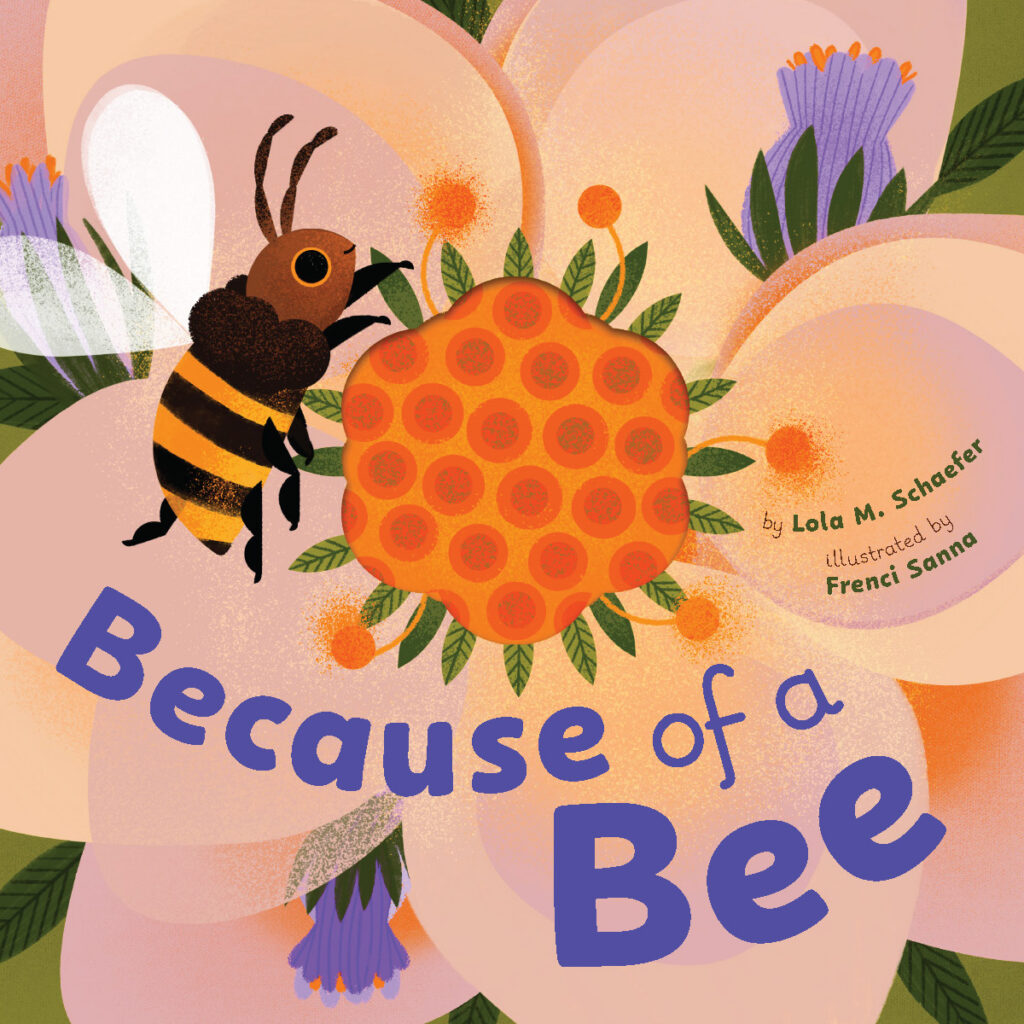
My friend Lola Schaefer has a new book out, Because of a Bee (Chronicle). It’s a companion, of sorts, to her Because of an Acorn, and I have no doubt it’s going to be as BIG a hit as that one with preschools and kindergartens across America. Is this not a beauuuuutiful cover?!
I’m not the only one who thinks it’s great. School Library Journal says, “…sure to spark curiosity about how even the smallest creatures make a big impact.” And Booklist calls it “Eloquently concise and visually captivating.”
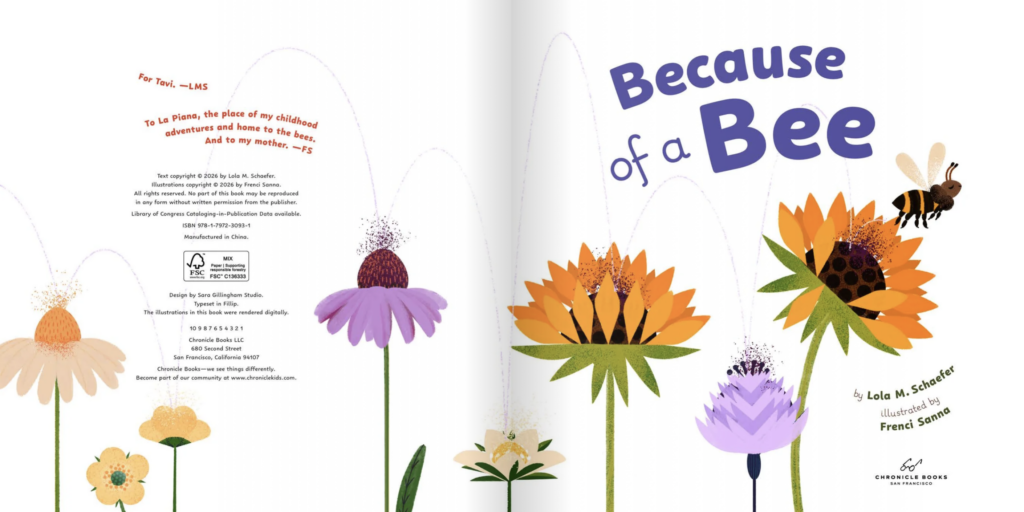
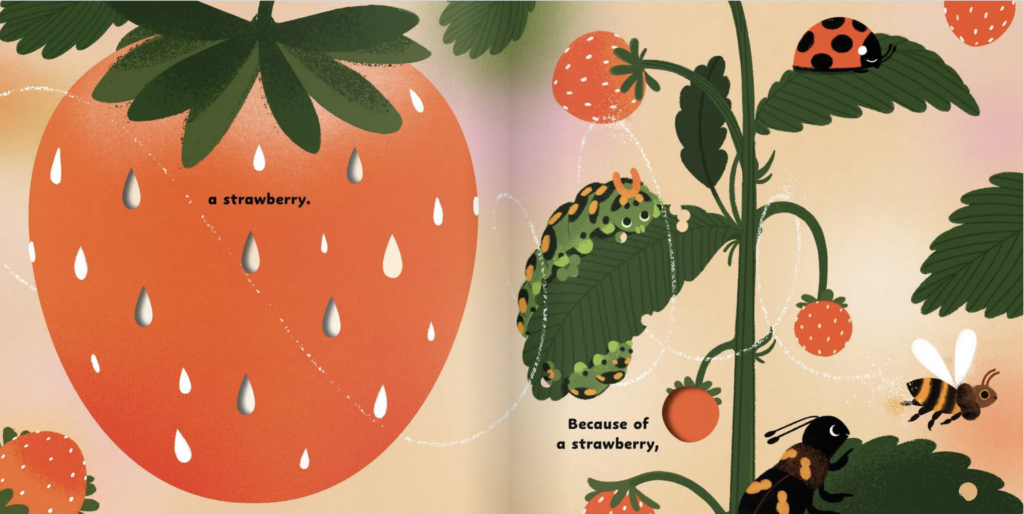
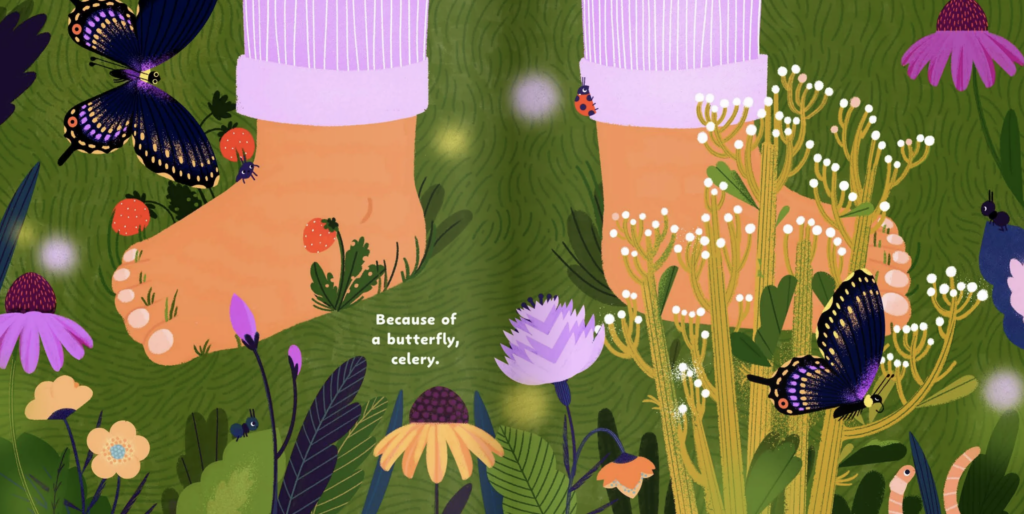
The book shows nature’s interconnectedness in a highly satisfying, circular way. Its simple, appealing text makes every word count: “Because of a bee, [page turn] a strawberry. Because of a strawberry, [page turn] a butterfly” etc. Vibrant illustrations in tones of greens, orange-golds, and purples bring readers up-close on every spread. So immersive! And there are cut-outs that have somehow been worked into every spread. Even on the cover, you can see that the middle of the flower is a die-cut. Kids will love this element.
I’m going to show you the title page, just because it’s such a perfect lead-in (and because I’m a flower nut).
Strawberries, anyone? (These are not sequential pages.)
And here’s a glimpse of the child who’s exploring this garden and enjoying the bees/butterflies:
Various elements all come together for one last, extravagantly colorful spread (that made me hungry). And ohhh, the backmatter! Along with an easy introduction to pollinators, each species of flora and fauna in the book gets a paragraph of its own.
Lola was kind enough to give terrific answers to my interview questions:
Jill: Wow. Frenci Sanna’s illustrations are stunning. They’re simple, yet vibrant, and match up so perfectly with your spare text. They aid in making this book a stellar pick for group read alouds, yet still work as a lap book. Did you have any say in bringing Sanna onto the project?
Lola: No. As an author, I contract the words of the text with the publisher. Sometimes editors will send me links to three or four illustrators’ portfolios and ask me which artists would be my top two choices. In this particular case, the acquiring editor, searched for someone who would not only bring captivating art to the project, but could also design placement of die-cuts to engage the readers. She asked Frenci Sanna to be the illustrator. I couldn’t be more pleased with the art and die-cuts. They truly make this book pop.
Jill: They really do! I know you often write books showing the interconnectedness of nature, and Because of a Bee fits into that so beautifully. Tell us about your other books with this similar theme.
Lola: It’s true. As a gardener and hiker, I’ve always appreciated the close-knit reliance that all life has on one another. I really do enjoy writing about the natural world and how it resembles an intricate puzzle, both in interdependence and majesty. My very first nonfiction picture book was This is the Sunflower (Greenwillow, 2000) which focused on how one sunflower can create food for many and seeds for more sunflowers. Because of an Acorn (Chronicle Books, 2016) was about a keystone species – the white oak. Most recently, If You Like Butterflies describes the life cycle of this insect, as well as its close relationship with flowers. And now, Because of a Bee introduces readers to bees – another keystone species, as well as different pollinators that visit plants and provide food.
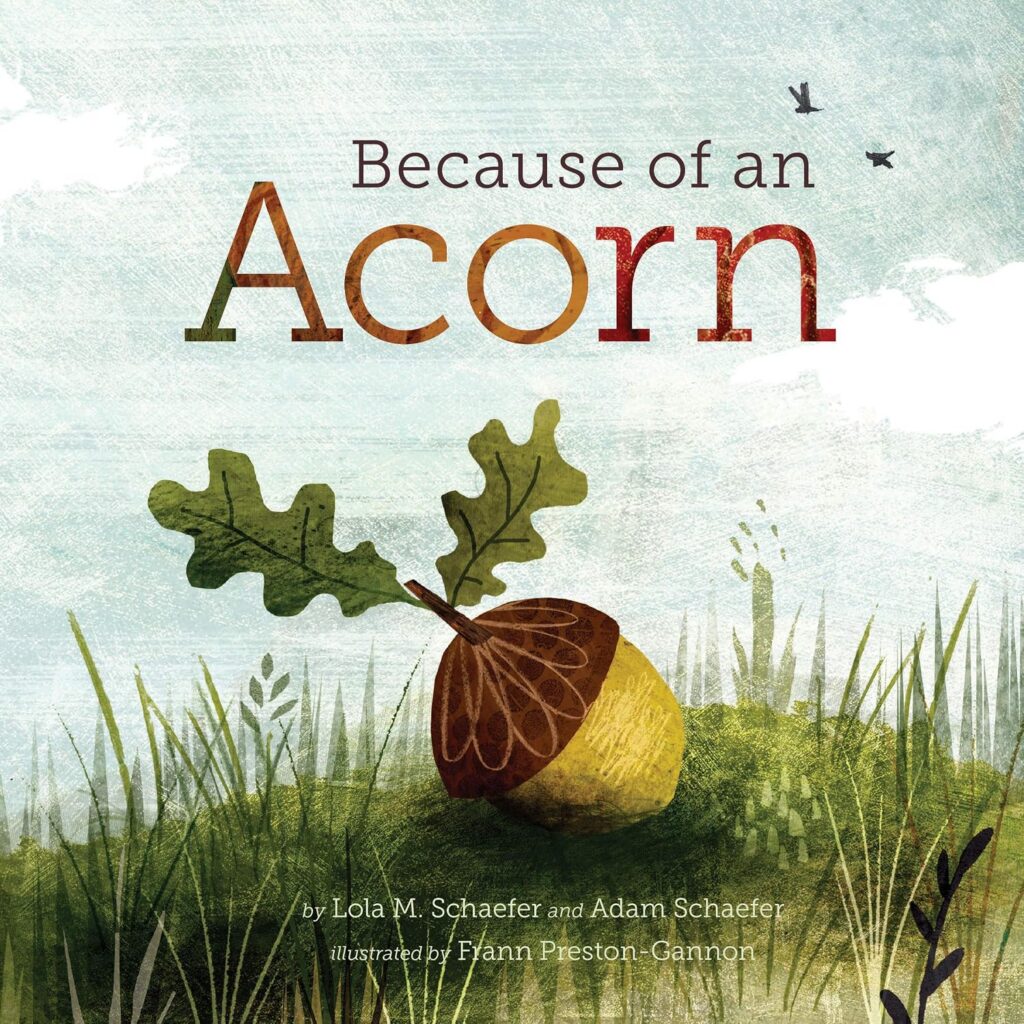
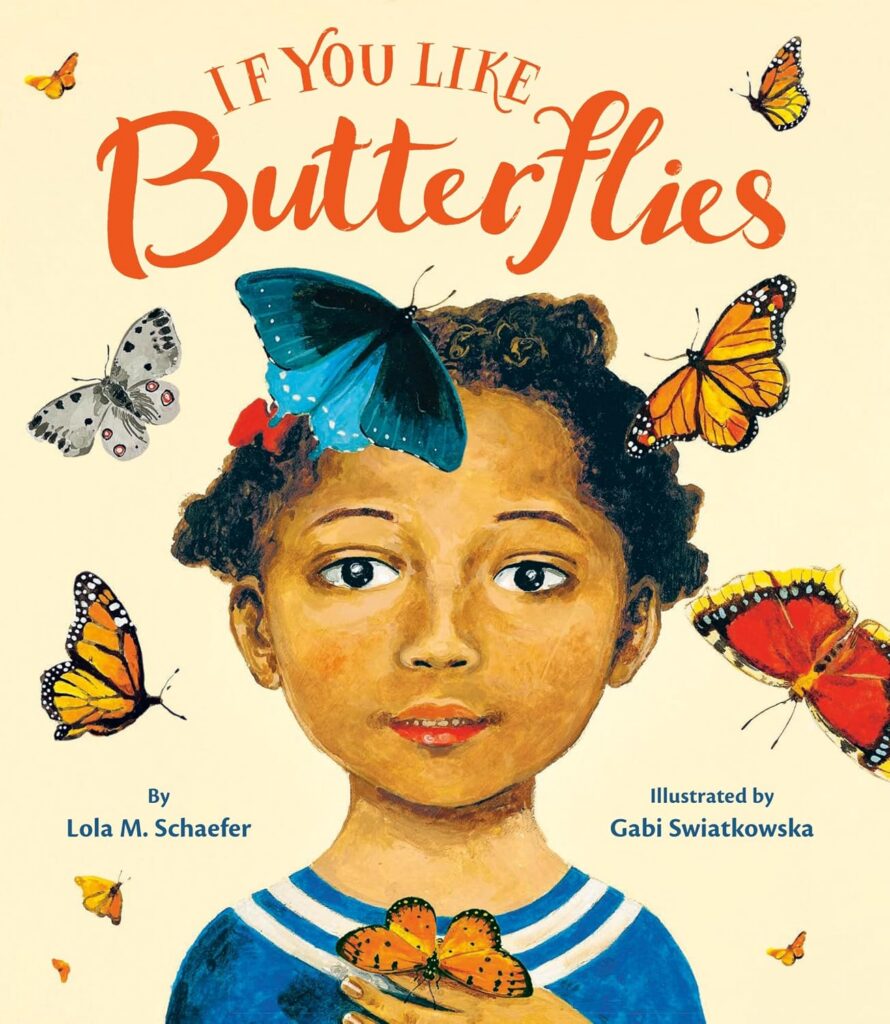
Jill: Your versatility should inspire us all, and newer writers especially. You are the author of picture books, graphic early readers, beginning readers, concept books, and educational titles. Topics include nature, science, holidays, humor, and more. Did you consciously decide to just … do it all?
Lola: As with many writers, I began writing what was important to me. There was no plan. Still none. I write from curiosity, interest, passion, and joy. To be truthful, I typically work on 2-3 different projects simultaneously until one demands more attention to take it to completion. Of course, topic and presentation are first considerations, but it quickly becomes all about the children who might read it. What would they like? What would grab them? Engage them? Make them want more? I do write with the child in mind. That probably is an offshoot of being a classroom teacher for many years.
Because my process centers around curiosity and passion, I typically don’t write the same kind of book again and again. For me, it’s exciting to try all genres, formats, and structures. I think that is what has sustained me over the years – the variety and possibilities. It definitely has helped me grow as a writer. Experimenting with different genres and formats keeps everything fresh, but it also demands more time studying the craft. However in the end, I not only create a new kind of book (for me), but the satisfaction that comes with taking those risks is quite rewarding.
Jill: Because of a Bee is rather short and follows a pattern. Are these kinds of books easy to write? Are there any challenges that we don’t notice, since the book reads effortlessly.
Lola: The short answer is no. Because of a Bee took more than a year to complete. It’s true that I used the same structure from Because of an Acorn, but there are so many considerations when writing nonfiction.
The research always takes more time than I think it will. Maybe it’s because I get so enthralled with learning about the topic and what scientists have recently discovered.
But it’s also about accuracy. I don’t want to write anything for children that’s not 100% accurate. That means not just speaking with one expert or reading one scientific paper. There needs to be a consensus with resources.
In this book, I knew I wanted to start with a bee and end with a bee, but showing other pollinators proved quite tricky. I had to find one ecosystem where there would be a variety of plants that produce foods and then learn which pollinators visit those plants.
I’m glad it reads effortlessly, however writing it was quite a challenge. Even after I had a list of plants and pollinators, I had to decide how to progress from one to another in a natural way.
Don’t misunderstand me. I love writing this kind of book, but it does take a lot of trial and error before all the pieces fall into place. Once they do, Hallelujah! In this case, the feast could contain different foods made from the pollination and fertilization of these plants and more.
Jill: Something newer writers ask me again and again: How do you know when an idea is worth fleshing out?
Lola: That is a GREAT question. I don’t know if there is a great, or even good, answer. Writers can easily be enamored with the initial idea. It sounds alluring, fascinating, better than anything we’ve conceived in the past. At that point, we have a choice. Either write the idea in a notebook or sit down and draft it quickly. If you go with the second choice, put that draft aside for a few weeks. When you reread it with a calmer head, it’s time to think about:
- Is this an important topic or story? (yes, even if it’s funny!)
- Will it resonate with kids?
- Is there an even stronger, more original way to format or present this?
- Who’s the target audience?
- How many other books have been recently published with this idea?
- Do you have the energy to write and revise this for a few months?
- Are there other layers you can add to this to make it stronger?
At that point, you either take a leap of faith and invest serious time and effort into that piece, or you decide to revisit it at a later time.
Gut instinct is also important when evaluating an idea. Do you just KNOW? If you’re reading the newest books as they debut, the reviews, and the awards lists, then you will definitely know what’s working with kids today and what isn’t. Always follow your educated intuition.
Jill: THANKS, Lola, for visiting with us today. So gracious of you to share such Invaluable advice with our readers!
What a great book and interesting post. I track with so many things Lola shared about her writing process and learned some great things too. Thanks!
Glad we made a connection, Suzanna. Continued good luck. As you know, writing is a journey.
Such a beautiful book. Thanks for sharing, Lola.
Just read your latest interview, Leslie. Great fun and I learned more about YOUR process.
I loved BECAUSE OF AN ACORN and the bees that pollinate our garden. What a clever and delightful way to introduce children to the ecosystem that brings our food. Congratulations!
Thank you, Kathryn. It is such a layered, complex relationship. I learned a lot writing this book.
Great book and such an informative post. I love the questions to ask yourself. Thank you for sharing Jill and congrats Lola on another beautiful book.
Thank you, Deb. I wish I could take credit for the beauty, but that’s all Frenci. What a talent!
I just got this book from my library. It is GORGEOUS!!!! Congrats!!!
Hello Debra, So happy that you’ve seen a copy in-person and like it. Thank you for the kind words.
I’m eager to get my hands on this one!!!
Hopefully, libraries will have it SOON, Tricia. Thanks for your enthusiasm.
What a gorgeous new book! I can’t wait to find and read it. And such ann illuminating interview. Thank you Lola & Jill!
You’re welcome, Patricia. Jill asks just the right questions, doesn’t she?
This is a great post! I love the phrase “follow your educated intuition.”
Thank you.
Thank you, Susan. Think how often we need to rely on that!
Lola, such a gorgeous book with fabulous reviews! Congratulations! … I have to get my hands on your butterfly book.
Thank you, Kathy. Oh, the art in both of these books is over-the-moon wonderful. I’m so lucky to have such amazing artists!
Thank you, Lola and Jill! So many things to enjoy and learn! The gorgeous text and illustrations, the thoughts about process and next books to write, and the list of questions about “How do you know when an idea is worth fleshing out?”
So glad you enjoyed the interview, Colleen. Children’s books are the BEST!
Can’t wait to read this one…looks wonderful.
Thanks, Buffy. I hope you enjoy it!
Great interview, Jill and Lola! Love the interconnectedness of this story. Fun and fascinating!
Thanks, Judy. Anxious to see what your next book will be!
Great tips for deciding which idea to concentrate on next! Thank you, Jill and Lola!
Putting these titles on my TBR list. Love books about our natural world and our connection to it.
Thanks, Marty.
I hope you enjoy each of the titles.
Lola
This sounds like a terrific book with a clever ending to tie the pieces together!
Thanks, Debra. As we all know . . . clever endings are NEVER easy.
Enjoy!
Great interview and concept for kids NF! Congratulations, Lola! Love the die-cut!
What a delightful book! I love the circular concept showing nature’s interconnectedness. Thank you for a lovely interview, Lola and Jill.